
Normale Ansicht

Mozilla veröffentlicht Firefox 134

07. Januar 2025 um 22:04

Mozilla hat Firefox 134 für Windows, Apple macOS und Linux veröffentlicht. Dieser Artikel fasst die wichtigsten Neuerungen zusammen – wie immer auf diesem Blog weit ausführlicher als auf anderen Websites.

Download Mozilla Firefox für Microsoft Windows, Apple macOS und Linux

Endnutzer-Neuerungen von Firefox 134

Für Nutzer in den USA und Kanada wird schrittweise ein angepasstes Layout für die Startseite ausgerollt, welches bis zu vier statt drei Content-Empfehlungen pro Zeile erlaubt und die Positionierung von Logo und Wetter-Widget so anpasst, dass die Suchleiste, Verknüpfungen und Content-Empfehlungen weiter oben erscheinen.

Firefox View sowie die Sidebar für synchronisierte Tabs zeigen nicht mehr nur maximal 50 Tabs von anderen Geräten an, sondern bis zu 5.000.

Firefox folgt nun stärker der HTML-Spezifikation, was die vorübergehende Benutzeraktivierung betrifft. Durch diese Änderung wird die Blockierung von Popups in Fällen, in denen frühere Firefox-Versionen zu aggressiv waren, weniger streng gehandhabt, wodurch fehlerhafte Blockierungsaufforderungen reduziert werden.

Unter Linux werden jetzt Touchpad-Haltegesten unterstützt. Das bedeutet, dass der kinetische Bildlauf unterbrochen werden kann, indem zwei Finger auf das Touchpad gelegt werden.

Bei Verwendung eines Convertible-Gerätes mit Windows 11 passt Firefox automatisch die Oberflächengröße beim Wechsel zwischen Laptop- und Tablet-Modus an, wenn die Touch-Oberfläche für die Tablet-Nutzung aktiviert ist.

Ein Problem mit der Übersetzungsfunktion wurde behoben, welches verursachen konnte, dass manche Inhalte nicht angezeigt worden sind, wenn die automatische Übersetzung aktiviert ist. Außerdem wurde ein Problem der Übersetzungsfunktion in Zusammenhang mit select-Feldern behoben.

Das Erweiterungs-Menü unterstützt die Anzeige von Warnmeldungen für „Soft Blocks“, also Erweiterungen, welche von Mozilla zum Beispiel aus Gründen der Stabilität aus der Ferne deaktiviert worden sind, aber vom Nutzer wieder aktiviert werden können.

Mit browser.tabs.insertAfterCurrentExceptPinned wird eine neue Option in about:config bereitgestellt, um zu beeinflussen, wo Links, die aus angepinnten Tabs heraus geöffnet werden, angezeigt werden. Standardmäßig öffnen diese am Anfang der Tableiste. Nach Setzen des Schalters auf true öffnen diese am Ende der Tableiste.

Die Leseansicht respektiert jetzt die in den Schriftarten-Einstellungen hinterlegten Schriften für Serif, Sans Serif und Feste Breite.

Die Performance der Quelltext-Ansicht wurde verbessert.

Das Problem auf macOS Sonoma und höher wurde behoben, dass neben dem Öffnen des Emoji-Wählers auch der Buchstabe „e“ in ein Textfeld eingefügt wurde, wenn die Tastenkombination Fn + e gedrückt wurde. Ebenfalls kann der Emoji-Wähler über die Tastenkombination Ctrl + Cmd + Leertaste geöffnet werden. Dabei hatte sich dieser, ebenfalls seit macOS Sonoma, sofort wieder geschlossen. Auch das Problem wurde behoben.

Für den Zugriff auf lokale Adressen ist seit macOS Sequoia eine neue Berechtigung auf Systemebene erforderlich. Die in diesem Fall von Firefox gezeigte Fehlerseite zeigt jetzt einen entsprechenden Hinweis an.

Ebenfalls macOS betrifft eine Änderung bei der Schriftglättung, deren Ergebnis nun mehr dem von Safari entsprechen sollte.

Die Unterstützung für das Debuggen von Erweiterungen wurde verbessert, unter anderem durch ein automatisches Nachladen des Quellcodes der Erweiterung im Debugger, wenn die Erweiterung neu geladen wird.

Das Netzwerk-Panel der Entwicklerwerkzeugezeigt Informationen über Early Hints an, einschließlich einer speziellen Anzeige für den 103 HTTP-Statuscode in der Benutzeroberfläche an.

Mehr Sicherheit für Firefox-Nutzer

Auch in Firefox 134 wurden wieder mehrere Sicherheitslücken geschlossen. Alleine aus Gründen der Sicherheit ist ein Update auf Firefox 134 daher für alle Nutzer dringend empfohlen.

Die Content-Sandbox unter Windows wurde um eine weitere Stufe auf Level 8 erhöht.

Verbesserungen der Webplattform

Firefox 134 unterstützt den Video-Codec HEVC. Allerdings bisher nur auf Windows und bei Verwendung eines Gerätes mit Unterstützung für diesen Codec.

Die CSS-Eigenschaften align-self und justify-self sowie die CSS-Shortendeigenschaft place-self werden jetzt für absolut positionierte Elemente unterstützt.

WebRTC-Simulcast von gemeinsam genutztem Video mit dem VP8-Codec wird jetzt unterstützt. Von anderen Videoquellen war dies bereits möglich.

Dies war nur eine kleine Auswahl der Verbesserungen der Webplattform. Eine vollständige Auflistung lassen sich in den MDN Web Docs nachlesen.

Feature-Vorschau

SmartBlock-Platzhalter für Instagram- und TikTok-Content

Durch Setzen von extensions.webcompat.smartblockEmbeds.enabled auf true können auf Websites eingebettete Instagram- sowie TikTok-Inhalte durch einen Platzhalter ersetzt werden. Als weitere Voraussetzung muss hierfür der Schutz vor Aktivitätenverfolgung in den Datenschutz-Einstellungen auf die strenge Stufe geschaltet sein. Erst nach einem Klick auf einen Button wird dann der tatsächliche Inhalt dann geladen. In Zukunft soll diese Funktion auch für weitere Einbettungen zur Verfügung stehen.
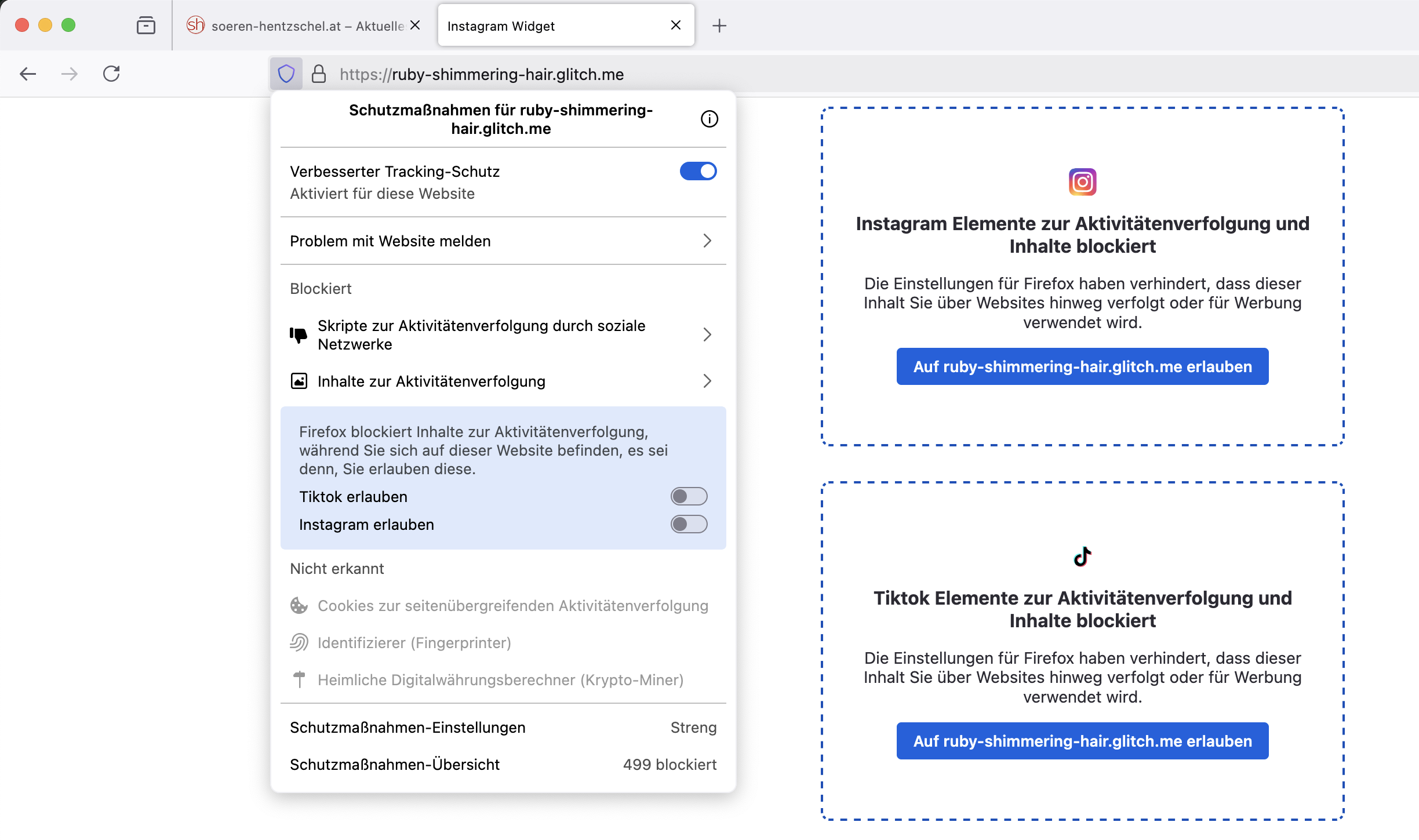
SmartBlock Embeds in Firefox 134

Entladen von Tabs

Wird über about:config der Schalter browser.tabs.unloadTabInContextMenu per Doppelklick auf true gesetzt, steht im Kontextmenü der Tabs eine neue Option zur Verfügung, um den jeweiligen Tab zu entladen und damit Ressourcen freizugeben.

Der Beitrag Mozilla veröffentlicht Firefox 134 erschien zuerst auf soeren-hentzschel.at.

Linux Q&A - Hauke und Jean beantworten Eure Fragen! - Live

07. Januar 2025 um 18:31

💾

Heute Abend klären wieder Hauke und Jean Deine Fragen live!
Wenn Du das Video unterstützen willst, dann gib bitte eine Bewertung ab, und schreibe einen Kommentar. Vielen Dank!

--------------------

Links:

Frage stellen: https://ask.linuxguides.de

Forum: https://forum.linuxguides.de/
Haukes Webseite: https://goos-habermann.de/index.php
Nicht der Weisheit letzter Schluß: youtube.com/@nichtderweisheit
Linux Guides Admin: https://www.youtube.com/@LinuxGuidesAdmin

Professioneller Linux Support*: https://www.linuxguides.de/linux-support/
Linux Mint Kurs für Anwender*: https://www.linuxguides.de/kurs-linux-mint-fur-anwender/
Ubuntu Kurs für Anwender*: https://www.linuxguides.de/ubuntu-kurs-fuer-anwender/
Linux für Fortgeschrittene*: https://www.linuxguides.de/linux-kurs-fuer-fortgeschrittene/
Offizielle Webseite: https://www.linuxguides.de
Tux Tage: https://www.tux-tage.de/
Forum: https://forum.linuxguides.de/
Unterstützen: http://unterstuetzen.linuxguides.de
Twitter: https://twitter.com/LinuxGuides
Mastodon: https://mastodon.social/@LinuxGuides
Matrix: https://matrix.to/#/+linuxguides:matrix.org
Discord: https://www.linuxguides.de/discord/
Kontakt: https://www.linuxguides.de/kontakt/
BTC-Spende: 1Lg22tnM7j56cGEKB5AczR4V89sbSXqzwN


Haftungsausschluss:
-------------------------------------
Das Video dient lediglich zu Informationszwecken. Wir übernehmen keinerlei Haftung für in diesem Video gezeigte und / oder erklärte Handlungen. Es entsteht in keinem Moment Anspruch auf Schadensersatz oder ähnliches.

*): Werbung

Up for 2025 YH4F? 2024 Winner Sofía Aritz shares why it's a must-join!

06. Januar 2025 um 23:00

Up for 2025 YH4F? 2024 Winner Sofía Aritz shares why it's a must-join!

The fourth round of Youth Hacking 4 Freedom (YH4F) is officially underway, with its opening event on 9 January. Sofía, one of the 2024 winners, gives us an insight into her project, how she came up with her idea, and her experience of the competition in general. Find out more! And do not forget to register for this edition!

A new edition of Youth Hacking 4 Freedom (YH4F) is starting this week with its opening event on Thursday 9 January. At this event, the YH4F organizers will explain how this competition works and will resolve your doubts so, if you still haven’t done it, register! This unique programming competition, organized by the Free Software Foundation Europe, encourages young Europeans to develop a personal technical project under one premise: whatever it is, it has to be Free Software. But it is more than just a contest: it's an opportunity for young talent to showcase their creativity, learn new skills, and contribute to their community.

We spoke with Sofía Aritz, one of last year's winners, who shared her journey from doubting to register to participate due to a lack of ideas to winning with her project Identity, a project she developed almost at the end of the programming phase. Identity is a general purpose memory storage app, but the data you store in Identity has an unlimited number of use cases such as medical ones, helping people suffering dementia, palliative care, depression, etc.

FSFE: Hi Sofía! First of all, congratulations on being one of the winners of the last round of YH4F! Could you please briefly introduce yourself and tell us what you like to do before we delve into your project?

Sofía: Thank you very much! My name is Sofía Aritz and I am 18 years old. I love reading and programming, these two have been my greatest passions for the last decade. Over the years, I’ve applied my computer knowledge in different areas: music, databases, data sovereignty...

FSFE: What was your first experience with programming and how did you start learning it? Was it with Free Software?

Sofía: My first experience with programming was at the age of five, when my uncle gave my mother a printed copy of the Python tutorial. The prospect of being able to control a computer was one of my biggest motivations for learning to program. I was able to learn Python thanks to both the tutorial and the fact that it is Free Software.

Register for Youth Hacking 4 Freedom 2025!

Register

FSFE: How and why did you decide to join YH4F? What do you like the most about the contest?

Sofía: Although YH4F was exactly what I had been looking for years, I had doubts about joining it because at that time, I had no (good) ideas and I was in my last year of high school, so I was quite busy. But since it sounded really good [a programming contest for young people who could work on whatever they wanted!], I thought about it and finally joined at the end of February 2024. I was sure at the end, I was going to have an idea.

About what I like the most… It's hard to choose: the concept of YH4F, the groups meetings, my peers…

FSFE: So, when you joined, you didn’t have an idea. How did you come up with your final project, Identity?

Sofía: I didn't come up with the idea of Identity until the programming phase was almost over. My mother is a singing teacher, but she's done some medical work in the past. One of the things she researched was the relationship between dementia and music. Over the years, she has tried to look for things similar to Identity, but couldn't find any. Then one night, we started talking about the relationship between dementia and music, and the idea of Identity became a reality.

Since I didn’t have any meaningful ideas in mind when I joined, I started working on an application to help my school manage their computers, but similar Free Software projects already existed and the idea didn’t really appeal to me. I also had a couple of other ideas that I worked on for a very short time, but I can’t remember what they were.

In the beginning, Identity was going to be a music-centric app with integrations to platforms such as Libre.fm, Spotify… but after discussing possible use cases and who Identity could be useful to, we landed on the current concept of Identity. Together, my mother and I, we came up with the current idea of Identity.

FSFE: What motivates you to work on your project? How can Identity be useful for everyone?

Sofía: What motivates me the most is the fact that Identity can help millions of people, not just those with dementia, but everyone! That's why I'm currently working on the project.

Right now Identity is just a general purpose memory storage app, but the data you store in Identity has an unlimited number of use cases. What I'm currently researching is how memories can help people in different areas: dementia, palliative care, depression, etc.

On a technical level, I plan to implement a plug-in system that will allow anyone to use the data they store for specific purposes: from things like an "Identity Wrapped" to more medically focused use cases.

This is one of the open questions from my presentation during the award ceremony, and even though things are clearer now, it is not yet resolved, but I am working on it!

FSFE: What were the main problems or challenges that you encountered during the programming phase?

Sofía: I didn't face many technical challenges while working on the project. I used a tech stack that I was familiar with and didn't worry much about code quality and scalability. I had a huge time constraint and I decided to just build a proof of concept.

The biggest challenge was working on the project without having a clearly defined idea. I started coding while I was still discussing with my mother what Identity would become and what Identity would be used for.

FSFE: Did you work on your project alone or had any help by others? How did you learn so much about the needs of elderly people?

Sofía: I did all of the programming myself, but I got feedback and ideas from a dozen of people who were really invested in the idea of Identity. Without those people, especially my mother, Identity wouldn't be what it is today.

I did a lot of research into how the use of memories could benefit palliative care and dementia patients, but the cornerstone in the initial phases was my mother. She had already done research on these topics some years ago.

FSFE: How has participating in YH4F and working on your project affected you personally? What have you learned about yourself through this experience?

Sofía: Participating in YH4F has changed my life for the better. I've learned how to manage projects efficiently, how to work on a project whose requirements change constantly, how to give and receive constructive and actionable feedback…

I've always had loads of energy and motivation and, thanks to YH4F and my current internship at the FSFE, I can focus that energy and motivation on changing the world for the better.

FSFE: Do you think you will continue working on your project and what would be some next steps you would like to take? Are you planning to improve the documentation so that more people can reuse your projects?

Sofía: Of course! Right now I'm working with some doctors specialized in palliative care and with some experts on the field of data security to make sure that Identity is as secure and as useful as it needs to be.

I'm rewriting Identity with a focus on scalability, interoperability, security, and modularity, and one of the things I am focusing on is proper and useful documentation. In the future, Identity may have to interoperate with existing medical systems, so documentation is one of the most important aspects of the project.

FSFE: Is there any kind of advice that you would like to tell new Youth Hacking 4 Freedom participants?

Sofía: I have a huge list of advice I would give people participating in Youth Hacking 4 Freedom, but there is one that I would highlight: don't be afraid to submit unfinished projects!

Identity works, but there are many things that don't (e.g. the trustee system) and I thought about not submitting Identity to YH4F.

Thankfully my mother encouraged me to submit it and my life has completely changed for the better ever since!

FSFE: What are your future plans in the area of Free Software?

Sofía: I'll continue working on Identity and contributing to Free Software projects, as I've been doing for the last few months. But my focus has shifted. I have just started an internship at the FSFE, in which I will learn how to do public awareness and policy work to improve the state of Free Software in Europe!

FSFE: Thank you Sofía for your time and for sharing your thoughts and insights about Youth Hacking 4 Freedom. It is a pleasure to welcome you to the FSFE staff team! It is truly amazing to see what you have accomplished due to Youth Hacking 4 Freedom.

The 2025 edition of Youth Hacking 4 Freedom started on 1 January with its programming phase. On 9 January, the competition will officially kick off with an opening event in which participants will get all the information about the contest and will be able to solve all their questions. Moreover, the event will include former participants that will tell about their experience and will give some tips on how to find a project and making it a winner.

Late registration is possible but we recommend you to register as soon as possible to be able to meet other participants. Check out the YH4F website to find out all the details of this competition or feel free to reach out to the organisers via mail! Thanks to our donor Reinhard Wiesemann and our sponsor Proxmox Server Solutions GmbH for making this competition possible.

Support FSFE

GOG Preservation Program auch für Linux geplant

07. Januar 2025 um 12:44

Alte Klassiker spielbar machen: Mit dem GOG Preservation Program wird der Erhalt von Spielen aus vergangenen Jahrzehnten sichergestellt. Neben Windows sollen bald auch Linux-Nutzer von angepassten Versionen profitieren. Die Initiative vereint Technik und Nostalgie. Wie beeinflusst das Programm die Verfügbarkeit und Zugänglichkeit dieser Kulturgüter?

Der Beitrag GOG Preservation Program auch für Linux geplant erschien zuerst auf Linux Abos.

❌