Anmelden
Open Source: Linux-Kernel 6.9 veröffentlicht
 Der neue Linux-Kernel bringt Unterstützung für Rust auf ARM64, Intels FRED-Mechanismus, AMDs SNP und Updates für verschiedene Dateisysteme. (Linux, Dateisystem)
 Der neue Linux-Kernel bringt Unterstützung für Rust auf ARM64, Intels FRED-Mechanismus, AMDs SNP und Updates für verschiedene Dateisysteme. (Linux, Dateisystem)

The maintainer of the KeePassXC password manager at Debian has largely gutted the package. An alternative package contains all functions.

Der Maintainer des KeePassXC-Passwort-Managers bei Debian hat das Paket weitgehend entkernt. Ein alternatives Paket enthält alle Funktionen.
Die Diskussion um KI-generierte Inhalte bei Debian führt derzeit nicht zu Maßnahmen. Die bestehenden Richtlinien seien ausreichend, so die Entwickler.

Der Paketbetreuer des Passwortmanagers KeePassXC bei Debian hat die Netzwerkfunktionalität aus dem Paket entfernt und sich damit wenig Freunde gemacht.


Nicht immer lässt sich zeitnah über jede Neuigkeit berichten, manche Ereignisse sind es aber dennoch Wert, Erwähnung zu finden. In dieser Zusammenfassung überblickt die Redaktion alle wichtigen Meldungen aus der Linux-Welt der vorangegangen Woche.

Das Update des Open-Source-Synchronisierungs-Tools FreeFileSync auf Version 13.6 umfasst neben kleineren Modifikationen wie der kompakten Anzeige des übergeordneten Pfads für mittlere und große Zeilengrößen auch Optimierungen bei bestehenden Funktionen sowie vor allem Fehlerbereinigungen.
 Redis ändert nach 15 Jahren sein Lizenzmodel. Was bedeutet das für die Nutzer der beliebten Key-Value-Datenbank? (Datenbank, Server-Applikationen)

An image mode for RHEL and the new RHEL AI – Red Hat presented interesting innovations for its enterprise Linux at the Summit.
Nach zwei Wochen Pause geht die Berichterstattung auf LinuxNews weiter. Es folgt eine subjektive Auswahl von News aus den letzten beiden Wochen.


Ein Image-Modus für RHEL und das neue RHEL AI – beim Summit zeigte Red Hat interessante Neuerungen für sein Unternehmens-Linux.
 Nach der Veröffentlichung von Fedora 40 im April gibt es nun den Fedora Asahi Remix, der diese Version von Linux auf Apple Silicon bringt. (Asahi Linux, Server)

Linux-Server und Netzwerkdienste effektiv und umfassend vor Angriffen schützen - von physischer Sicherheit über Verschlüsselung und 2FA bis hin zu SELinux.
 Seit über zehn Jahren klagen Terraform-Nutzer über unverschlüsselte state files. Version 1.7 der freien Alternative Opentofu bietet nun optionale Verschlüsselung an. (Security, Dateisystem)

Der kostenlose Stresstest und Benchmark für Grafikkarten FurMark ist in aktualisierter Version 2.3.0.0 mit dem Support für Raspberry Pi OS erschienen. Ebenfalls neu ist die Anzeige der Lüfterdrehzahl während des Testlaufs im Kontrollmenü. Mit dem Update gehen auch Optimierungen einher und es werden kleinere Fehler beseitigt.

Der Open-Source-Debugger x64dbg eignet sich für Reverse Engineering und Malwareanalyse. Er bietet viele Funktionen zum Nachvollziehen innerer Programmabläufe.
 Data Science und künstliche Intelligenz verändern die Welt nachhaltig. Gemeinsam mit StackFuel bietet die Golem Karrierewelt ein breites Spektrum an Workshops, die praktische Fähigkeiten in den Technologiefeldern vermitteln. (Golem Karrierewelt, Python)

At its summit, Red Hat also shows that there is no way around AI. But you won't find a chatbot or another OpenAI partnership.

Auf seinem Summit zeigt auch Red Hat, dass an KI kein Weg vorbeiführt. Doch noch einen Chatbot oder eine weitere OpenAI-Partnerschaft sucht man vergeblich.
May comes with legal news such as the Legal & Licensing Workshop and the Bitcoin lawsuit regarding the liability of Free Software developers. We also talked to two 2023 YH4F participants and our Danish local group sent an Open Letter to their parliament. Did you see that Ada & Zangemann won a prize and that the French ebook version is now available?

Table of contents
"As in our democracies, the distribution of power in the field of technology is essential. And we need to show that an inclusive path is possible".
-Matthias Kirschner, thanking the Forum InCyber for the prize given to Ada & Zangemann.For the second year in a row, the Swedish city of Gothenburg hosted an edition of the Free Software Legal & Licensing Workshop (LLW), the annual conference for the Legal Network members. The 2024 edition brought new faces and great discussions and presentations on current legal and licensing issues related to technological developments such as AI.
Find out more about the Youth Hacking 4 Freedom participants of the 2023 edition. We are continuing this series talking with Antoni and Tobias: Antoni developed a dictionary to preserve endangered languages, and Tobias conceived a rich featured calendar.
Free Software is everywhere, with studies estimating that it is present in about 96% of the applications that we use. But what are the responsibilities and liabilities of the Free Software developers? A potential threat to Free Software developers looms in the form of an ongoing lawsuit in the UK involving Bitcoin and its core developers.
The FSFE Danish local group has sent an Open Letter to the IT spokespersons of all the political parties in the Danish Parliament, entitled “Digitalisation problems can be solved with Free/Open Source Software”. In this letter, the local group pointed out several examples of cases in which using proprietary software is harming citizens’ rights and privacy, for example the municipalities' strong wish to use proprietary software (Google Classroom) in schools, which is actively sharing students' private data to Google in violation of the GDPR.
The local group is currently waiting for an official answer from the parliamentarians though they have already received positive responses.
You can check the letter (in Danish) here.
The German public broadcasters ARD and ZDF have announced that they will integrate their media centres in future and publish their code as Free Software. Under the name ‘Streaming OS’, the software will be available to the general public under a Free Software licence.
In their announcement, the directors of the broadcasters emphasise that by publishing the code, they want to give something back to society that it has previously paid for. ARD and ZDF are thus addressing the core idea of our FSFE initiative ‘Public Money? Public Code!’. We are looking forward to seeing Streaming OS and its code in 2025!
 The Berlin group of the FSFE participated in the 2024 edition of the
Umweltsfestival (Environmental Festival) together with Bits&Bäume
Berlin and KDE Eco. Our volunteers explained to festival attendees the
sustainable use of computers with Free Software as well as other FSFE
initiatives such as Public Money, Public Code and
even answered questions about the Fediverse.
The Berlin group of the FSFE participated in the 2024 edition of the
Umweltsfestival (Environmental Festival) together with Bits&Bäume
Berlin and KDE Eco. Our volunteers explained to festival attendees the
sustainable use of computers with Free Software as well as other FSFE
initiatives such as Public Money, Public Code and
even answered questions about the Fediverse.
Do you want to help spread the word about Free Software to the younger generations? You can do it with an Ada & Zangemann reading! If you like children, this is an easy and a great way to talk to them about Free Software. And everyone who has done it has found it a really rewarding and enriching experience!
If you are interested in facilitating a reading of the book in schools or libraries, write to contact@fsfe.org.
We would love to hear from you. If you have any thoughts, pictures, or news to share, please send them to us at newsletter@fsfe.org. You can also support us, contribute to our work, and join our community. We would like to thank our community and all the volunteers, supporters, and donors who make our work possible, with a special mention to our translators who make it possible for you to read this newsletter in your mother tongue.
Your editor, Ana
Seit Nextcloud Hub 8 (29.0.0) ist ChatGPT nicht mehr über den Picker der Nextcloud zu erreichen. Dieser Umstand kann Nerven kosten, wenn OpenAI’s KI-Dienst hin und wieder genutzt wird und man plötzlich feststellt, dass dieser nicht mehr funktioniert. So ging es mir, als ich den in die Nextcloud integrierten KI-Assistenten einem kleinen Publikum vorstellen wollte. Da das neueste Release 29.0.0 noch recht frisch ist, findet man derzeit wenig Hinweise, wie man ChatGPT weiter nutzen kann.
Dies hat mich nun dazu bewogen einen kleinen Artikel hierzu zu schreiben. Grundvoraussetzung ist jedoch ein Account beim US-amerikanischen Softwareunternehmen OpenAI bei dem ein API-Key erstellt wird.
Des weiteren müssen in der Nextcloud die Apps OpenAI and LocalAI integration und Nextcloud Assistant hinzugefügt und aktiviert werden.

Im Anschluss wird der API-Key, wie im Screenshot zu sehen ist, in der App OpenAI and LocalAI integration hinterlegt.

Nun kann man über den neuen Nextcloud-Assistent das KI-Tool nutzen.


Viel Spaß!
Die Geschwindigkeit bei der lokalen Ausführung großer Sprachmodelle (LLMs) wird in Zukunft zu einem entscheidenden Kriterium für die CPU/GPU-Auswahl werden. Das gilt insbesondere für Software-Entwickler, die LLMs lokal nutzen möchten anstatt alle Daten an Anbieter wie ChatGPT in die Cloud zu übertragen.
Umso verblüffender ist es, dass es dafür aktuell kaum brauchbare Benchmarks gibt. In Anknüpfung an meinen Artikel Sprachmodelle lokal ausführen und mit Hilfe des Forum-Feedbacks habe ich die folgende Abbildung zusammengestellt.
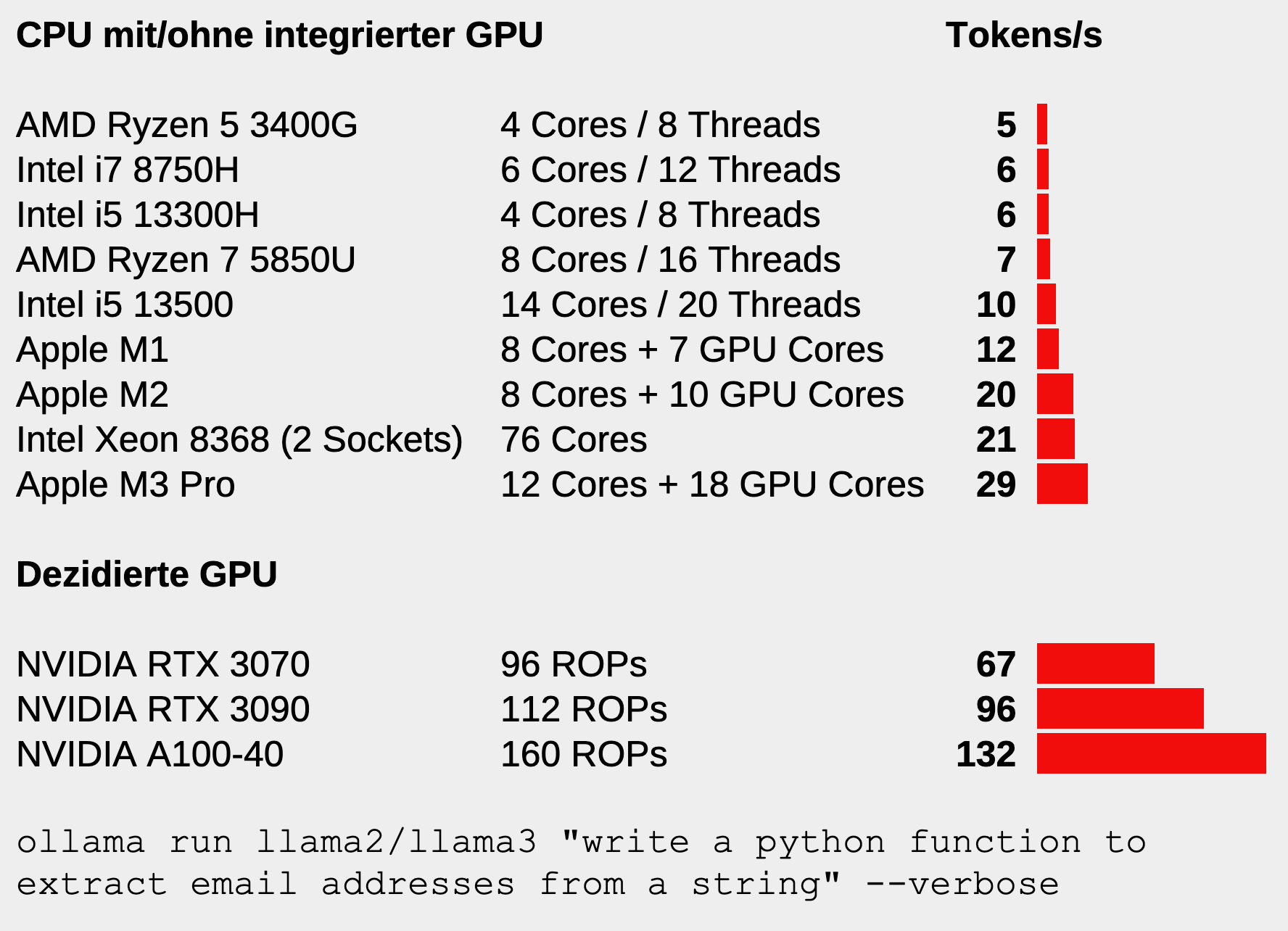
Die Geschwindigkeit in Token/s wird — zugegeben unwissenschaftlich — mit der Ausführung des folgenden Kommandos ermittelt:
ollama run llama2 "write a python function to extract email addresses from a string" --verbose
oder
ollama run llama3 "write a python function to extract email addresses from a string" --verbose
Bei den Tests ist llama3 um ca. 10 Prozent langsamer als llama2, liefert also etwas weniger Token/s. Möglicherweise liegt dies ganz einfach daran, dass das Sprachmodell llama3 in der Standardausführung etwas größer ist als llama2 (7 versus 8 Mrd. Parameter). Aber an der Größenordnung der Ergebnisse ändert das wenig, die Werte sind noch vergleichbar.
Beachten Sie, dass die im Diagramm angegebenen Werte variieren können, je nach installierten Treiber, Stromversorgung, Kühlung (speziell bei Notebooks) etc.
Helfen Sie mit! Wenn Sie Ollama lokal installiert haben, posten Sie bitte Ihre Ergebnisse zusammen mit den Hardware-Eckdaten im Forum. Verwenden Sie als Sprachmodell llama2 bzw. llama3 in der Defaultgröße (also mit 7 bzw. 8 Mrd. Parameter, entspricht llama2:7b oder llama3:8b). Das Sprachmodell ist dann ca. 4 bzw. 5 GByte groß, d.h. die Speicheranforderungen sind gering. (Falls Sie das LLM mit einer dezidierten GPU ausführen, muss diese einen ausreichend großen Speicher haben, in dem das ganze Sprachmodell Platz findet. Je nach Betriebssystem sind u.U. zusätzliche Treiber notwendig, damit die GPU überhaupt genutzt wird.)
Ich werde das Diagramm gelegentlich mit neuen Daten aktualisieren.