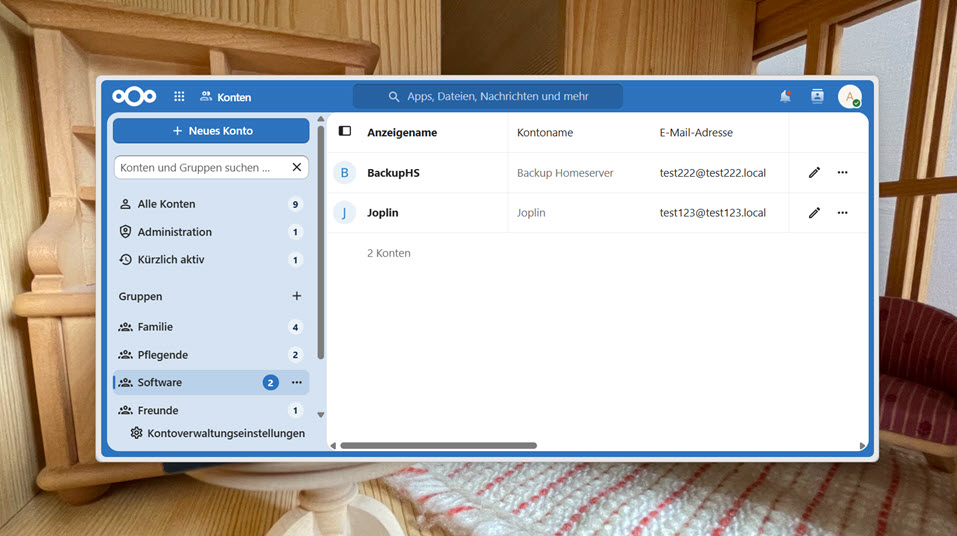
Pünktlich zum zehnten Geburtstag erscheint Nextcloud Hub 26 Spring.
Lese-Ansicht
Netflix-Synchronsprecher streiken gegen KI-Klausel
Viele bekannte Synchronsprecher, die Charakteren in beliebten Netflix-Serien ihre Stimme liehen, verweigern die Unterschrift unter neue Verträge, in denen sich Netflix das Recht einräumen lassen…
Bürosoftware: Euro-Office startet mit viel Kritik in Version 1.0
Ein europäisches Firmenbündnis veröffentlicht Euro-Office 1.0. Die Macher von Libreoffice kritisieren das Open-Source-Projekt. (Libreoffice, Opendocument) SoftMaker startet Betatest für Office 2026
Der Anbieter Softmaker hat die öffentliche Betaphase von SoftMaker Office 2026 angekündigt. Nach Angaben des Nürnberger Softwareherstellers können Interessierte die Vorabversion bis zum 31.
Auch OpenAI macht Börsengang offiziell
OpenAI, das mit seinem Chatbot ChatGPT den Boom der künstlichen Intelligenz ausgelöst hat, hat am Montag vertraulich einen Börsengang beantragt und damit die Weichen für einen der größten…
Smarte Verführung: Das Programmatic E-Mailing bei ORION
„Lieb doch, wie du willst“ ist das Motto von ORION Versand. Seit über 40 Jahren vertreibt das Unternehmen Liebesspielzeug für intime Momente, egal ob für Singles oder Paare. Doch da die Branche bei Werbe-Aktionen strengen Regularien unterliegt und der Streuverlust bei Plakat- und Internetwerbung hoch ist, mussten sich die Flensburger eine moderne, zielgenaue Lösung überlegen. Diese fanden sie mit einem Produkt des Münchner Software-Entwicklers AGNITAS.
Exploit: Google patcht viele Lücken in Chrome
Google hat ein Update für seinen Browser Chrome veröffentlicht. Das schließt dutzende Sicherheitslücken, darunter eine, für die es bereits einen Exploit gibt.
Die Document Foundation übt scharfe Kritik an Euro Office
Die neue Bürosoftware Euro Office steht kurz vor dem Start und löst bereits Streit aus. Die Document Foundation warnt in einem offenen Schreiben vor irreführenden Aussagen und sieht die digitale Souveränität Europas gefährdet. Euro Office entsteht aus einem Fork von ONLYOFFICE und wird von bekannten europäischen Technologieanbietern unterstützt. Die Suite soll eine europäische Alternative zu […]
Der Beitrag Die Document Foundation übt scharfe Kritik an Euro Office erschien zuerst auf fosstopia.
SoftMaker Office NX 2026 im öffentlichen Betatest
SoftMaker startet den öffentlichen Betatest für Office NX 2026. Verbesserungen gibt es unter anderem bei der Kompatibilität mit proprietären Formaten. Die KI-Funktionen wurden weiter ausgebaut.
Euro-Office erstmals stabil veröffentlicht
Euro-Office wird heute in Version 1.0 veröffentlicht. Es soll eine datenschutzkonforme, geopolitisch unabhängige Alternative zu Microsoft 365 und Google Docs bieten.
Ein Blick auf die Pebble Time 2
Ein kleiner Erfahrungsbericht zur neuen Pebble Time 2 Smartwatch.


Decades-long victory, bold Apple survey findings, legal workshop success & our 50th podcast episode
Digital Sovereignty needs Free Software
In the last weeks, we got the green light to intervene against Apple before the European Court of Justice for the second time (!) while the European Commission has included the “Public Money? Public Code!” principle in its Technological Sovereignty Package. And stay tuned! A new European consortium will be launching soon, and we are part of it!

This month is starting with good news: the European Commission included the Free Software Foundation Europe’s “Public Money? Public Code!” principle in the newly released Technological Sovereignty Package, which also contains the new "Open Source Strategy". If implemented, it could mark a paradigm shift towards making publicly financed software available as Free Software. But it is too early to lean back: Its success will depend on binding rules, long-term funding, and meaningful civil society involvement.
However, not all public administrations think the same: England’s National Health Service (NHS England) has made most of its public source code repositories private by default, based on concerns that public code repositories could be scanned by AI systems to identify vulnerabilities. At the FSFE we were clear about it: NHS England should not hide public code behind closed doors. De-publishing does not make code unseen, nor does it remove existing copies, and it is not an effective security measure. Instead, it removes a fundamental pillar for security: the ability of independent experts, researchers, and other public bodies to inspect, reuse, and improve the code, and to report on security issues.
We called on the Free Software community to push that decision back by signing an open letter to NHS England, calling on them to keep their code open. The community’s response was strong, with more than 500 additional signatures in the hours after our call. Shortly afterwards, the UK Government Digital Service issued new guidance making clear that public bodies should keep code public by default.
Digital sovereignty through Free Software was also the topic of our latest Software Freedom Podcast episode, in which Bonnie and Johannes talk with Petteri from X-Road about the current challenges for Free Software projects in public administrations. Listen to it!
You may already know that despite the need for digital sovereignty in Europe, funding for European projects such as the Next Generation Internet Zero (NGI0) programme was cut. We're glad to share some good news on this front: we recently announced a new European consortium for a resilient, home-grown technology European ecosystem: the Restack project. Operating under Horizon Europe, the FSFE is a partner of this cascade funding programme, designed to retain the strength of the NGI Zero approach. Our role will be to provide legal and licensing support for potentially over 200 Free Software projects and assist their growth into part of a wider European digital commons.
Defending interoperability in Europe
“With industry interests well represented by several interveners on the other side, the FSFE is there to ensure that civil society is equally heard — and that the court can decide with the full picture before it"
Dr. Martin Husovec, the lawyer representing FSFE in the case T-359/25 - Apple against the European CommissionIn a landmark development for Software Freedom in Europe, the Free Software Foundation Europe has been granted permission to intervene at the Court of Justice of the European Union in the case T-359/25 - Apple against the European Commission. This intervention aims to defend interoperability and Software Freedom in Europe and it is the second time the FSFE is intervening in a litigation at the CJEU in regards to the DMA and Apple. The previous case (T-1080/23) concerns Apple’s broader challenge to its DMA obligations and its designation as gatekeeper, while this case (T-359/25) focuses specifically on interoperability under Article 6(7) DMA and the legality of the European Commission’s decision specifying how Apple must implement those obligations in practice.
Following our work on the Digital Markets Act, we participated in the SCiDA Conference in Düsseldorf, a leading academic event focused on competition in digital markets. There, the FSFE was invited to present its work on interoperability in Android during a plenary session, highlighting the relevance of our work within ongoing policy and academic discussions.
The conference brought together senior representatives from competition authorities across Europe as well as members of the European Commission's DMA enforcement team. The conference provided an excellent opportunity to strengthen connections with key stakeholders and to further raise awareness of the FSFE's policy work on digital markets and users' freedom to control their devices.
Up for learning more about the DMA? We were invited for episode 5 of the "DMA Vox Populi" podcast about the DMA review. There, Dario discusses what the European Commission got right, where it fell short, and what must come next for software freedom and interoperability in Europe.
Youth Hacking 4 Freedom 2026
The 2026 edition of Youth Hacking 4 Freedom is reaching its peak. The programming period wraps up at the end of this month, and while participants can finally catch their breath, the jury will be getting to work evaluating their projects. In October, we will meet the 6 winners of this edition at the Award Ceremony weekend in Brussels.
For the fifth edition of YH4F we had over 80 participants from 21 countries! 😮 We can't wait to see what they have developed. And we are already planning for the next edition, so stay tuned!
From the stages: Ada, Digital Sovereignty, PIWO and more!
May has been a busy month! Our Polish local group took part in P.I.W.O. (the Poznań Free Software Event), where volunteers ran a booth promoting Free Software. And while the name might make us think of free "piwo" (that's beer in Polish), what participants got was free pizza.
In Berlin our group organized a Linux presentation day in which people could try Linux laptops and get all their questions answered about them.
Moreover, besides attending SCIDA, we participated in a panel about the DMA in Brussels. During the CPDP conference, we sat in the panel entitled "It takes two to tango: Public and private enforcement of the Digital Markets Act" at the CPDP conference, where we presented our work on the DMA enforcement, including our litigation against Apple at the European Union Court of Justice.
Digital sovereignty was also the topic in a lecture series in Regensburg, where, after watching the animated movie “Ada & Zangemann”, we took part in a discussion about this topic.
The FSFE is turning 25! And we want to celebrate it with you!Join us on 18 and 19 July in Cracow for a weekend full of Free Software with talks, networking, and of course, a cake! Wanna know more? Write us: contact@fsfe.org
Ada was also present at several events: we had a movie screening and a kids' workshop at the Tübingen Digital Freedom Days, where we also ran a booth. In Utrecht, at the NLUUG conference, our booth had a focus on Ada & Zangemann too. But the highlight this month was in Italy: our Italian community celebrated three years with Ada at an event in Pesaro with more than 50 primary school kids… and ice cream for everyone!

One last recommendation if you are a German speaker (also good for practising your German skills 😉): listen to the latest episode of the Engineering Kiosk podcast, featuring Ada & Zangemann! There Matthias talks with Andy and Wolfgang about a lot if interesting background details of this illustrated story.
Your support helps us move our work forward
We may be behind the wheel, but you’re the ones keeping us moving forward. You can also support us, contribute to our work, and join our community. Are you using social media? If so, do not forget to follow us there! You can also follow the FSFE news in your RSS Reader.
Your editor, Ana
Proton Drive rüstet auf und bereitet den Linux Client vor
Proton arbeitet an einer neuen Grundlage für seinen Service Proton Drive. Die Entwickler haben Drive technisch neu aufgebaut und damit die Basis für schnellere Apps und neue Plattformen geschaffen. Diese Modernisierung ebnet nach aktueller Ankündigung nun auch den Weg für den kommenden Linux Client. Im Zentrum steht ein gemeinsamer Kern für alle Proton Drive Anwendungen. […]
Der Beitrag Proton Drive rüstet auf und bereitet den Linux Client vor erschien zuerst auf fosstopia.
GNOME 50.2 bringt Verbesserungen für Shell, Mutter und Nautilus
GNOME 50.2 bringt viele Korrekturen und sorgt für spürbar mehr Stabilität. Die Aktualisierung richtet sich an alle Nutzer der aktuellen Desktop Reihe und verbessert zahlreiche zentrale Komponenten. Die überarbeitete GNOME Shell reagiert nun präziser auf Eingaben. Probleme bei Bildschirmfotos und der Auswahl von Bereichen an Monitorrändern treten nicht mehr auf. Auch der Bildschirmleser arbeitet zuverlässiger […]
Der Beitrag GNOME 50.2 bringt Verbesserungen für Shell, Mutter und Nautilus erschien zuerst auf fosstopia.
Flatpak 1.18 bringt AMD Compute Interface Support
Flatpak 1.18 ist erschienen und liefert ein Update, das vor allem AMD‑Nutzern Vorteile bringt. Die neue Version sorgt für mehr Stabilität und bessere Rückmeldungen bei Fehlern. Die wichtigste Neuerung betrifft AMDs Schnittstelle für GPU‑Berechnungen. Anwendungen mit DRI‑Zugriff können jetzt auch das Kernel Fusion Driver Interface nutzen. Das eröffnet mehr Möglichkeiten für Workloads, die stark auf […]
Der Beitrag Flatpak 1.18 bringt AMD Compute Interface Support erschien zuerst auf fosstopia.
Ladybird Browser passt Entwicklungskonzept an
Der von vielen mit Spannung erwartete unabhängige Ladybird Browser hat sein Entwicklungskonzept geändert und nimmt im Vorfeld einer ersten Alpha nur noch Code von offiziellen Entwicklern an.
ChatGPT soll zu Super-App werden
Wie die Financial Times berichtet, die sich dabei auf die Aussagen von mehr als einem Dutzend ehemaliger und aktueller Mitarbeiter von OpenAI stützt, will sich das Unternehmen stärker auf…
Euro Office gewinnt vor Veröffentlichung der ersten Version zehnten Partner
Euro-Office, ein Fork von ONLYOFFICE, wurde unter der Ägide von Branchengrößen wie Ionos und Nextcloud zu einer freien, souveränen und transparenten Office-Lösung für Unternehmen und…
ChatGPT führt Schutz vor Prompt Injections ein
ChatGPT rollt für alle Accounts, die kostenlosen eingeschlossen, einen neuen Sperrmodus (Lockdown Mode) ein, der bis zu einem gewissen Grad vor Angriffen mittels Prompt Injection schützt.
Euro-Office gewinnt einen weiteren Partner
Kurz vor der Veröffentlichung der ersten Version, ist auch die Tutao GmbH der Euro-Office-Gruppe beigetreten. Damit wird die europäische Office-Initiative nun von 10 Firmen getragen.


Location, Location, Location
Google und andere Anbieter fragen den genauen Standort ab, auch wenn man dies im Browser deaktiviert hat. Wie du das verhindern kannst, erkläre ich dir hier.